
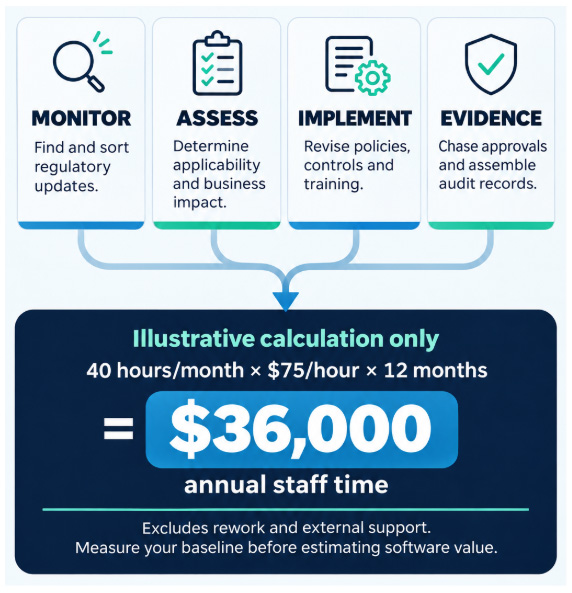
Without software, the cost of regulatory change at a bank is mostly staff time spent finding, assessing, mapping, implementing and evidencing each rule by hand. For one 2026 rule, the FDIC’s own estimates add up to 121 implementation hours per institution.
What follows sets out the cost lines, where manual hours go, that worked example, why smaller institutions pay more and how Predict360 applies.

Where the Hours Go in a Manual Process
A manual process spends staff time at five steps:
1. Find the change
Staff read agency websites, the Federal Register and email alerts, then log each item in a spreadsheet.
2. Assess applicability
A compliance officer reads each item to decide whether it touches the institution’s charter, products or size.
3. Map the impact
Staff search policies, procedures and controls by hand for every document the change affects.
4. Implement and assign
Tasks go out by email, and the tracker shows owners and due dates only if someone keeps it current.
5. Evidence completion
Before an examination, staff rebuild the trail from alert to updated procedure out of inboxes and shared drives.
An agency’s Paperwork Reduction Act estimate prices the implementation work for one rule. Steps 1 and 2 recur for every item reviewed, including items that turn out not to apply, and no agency estimate counts them. A written regulatory change management process makes each step explicit, whatever tools run it.
Worked Example: Pricing the FDIC Signage Rule
Agencies publish Paperwork Reduction Act burden estimates with each rule that imposes recordkeeping or disclosure duties. The FDIC’s January 2026 final rule amending its official sign and advertising requirements in 12 CFR Part 328 is a recent example.
Every figure in the worked example below comes from that rule or is arithmetic on its figures.
| Item | Figure | Source |
|---|---|---|
| Final rule published | 29 January 2026 | 91 FR 3801 |
| Effective date | 2 March 2026 | Final rule |
| Compliance date | 1 April 2027 | Final rule |
| FDIC-insured institutions subject to Part 328 | 4,388 (as of 30 September 2025) | FDIC economic analysis |
| Implementation: ATM and digital-channel signage | 41 hours per institution | FDIC PRA estimate |
| Implementation: policies and procedures | 80 hours per institution | FDIC PRA estimate |
| Labor cost per hour | $123 | FDIC, from BLS wage data |
| Implementation cost per institution | 121 hours × $123 = $14,883 | Arithmetic |
| Implementation cost across institutions | $14,883 × 4,388 = $65,306,604 | Arithmetic |
Why Smaller Institutions Pay More
A CSBS analysis published on 13 November 2025, covering its community bank surveys from 2015 to 2024, found that banks in the smallest size quartile spent roughly 11% to 15.5% of payroll on compliance tasks, against 6% to 10% for the largest. The authors concluded that regulatory costs “behave more like a fixed overhead cost than a variable one.”
Earlier St. Louis Fed research on 2014 data reached the same result. Compliance averaged 8.7% of noninterest expense at banks under $100 million in assets and 2.9% at banks with $1 billion to $10 billion.
Manual compliance methods remain common. In Wolters Kluwer’s 2025 Regulatory & Risk Management Indicator, released in December 2025, 88% of US banking respondents reported using manual processes and spreadsheets often or sometimes.
Predict360 Regulatory Change Management
Predict360 Regulatory Change Management collects regulatory intelligence and news from external sources in one feed and parses each update to highlight what changed. An AI-powered engine gives a preliminary assessment of impact on processes, documents, policies and controls.
Ask Kaia’s Regulatory Intelligence Agent identifies affected policies. Activities are assigned and tracked, stakeholders are notified automatically, and Power BI dashboards show regulatory exposure, so each change carries an owner and a status up to its compliance date.
Frequently Asked Questions
Why Is Regulatory Change Management Difficult Without Software?
Every step depends on someone remembering to do it. Finding a change relies on staff reading agency sites, impact mapping relies on searching documents by hand, and the evidence trail lives in inboxes. Each change also competes with the rest of the compliance calendar, so the tracker falls behind when several changes arrive at once.
How Do You Calculate the Cost of a Regulatory Change?
Multiply the staff hours spent on the change by a fully loaded hourly cost, then add consulting, legal and system costs. The FDIC’s method is a usable template: it prices hours at the 75th percentile of Bureau of Labor Statistics wages for the occupations involved, increased by 53% for non-wage compensation and 5% for wage inflation.
Does Regulatory Change Management Software Reduce Compliance Costs?
Software takes over finding, routing and tracking changes and keeps the evidence trail; drafting procedures and deciding how a rule applies stay with staff. The question that gives an institution its own figure is how many hours last year’s changes took at each of the five steps, and how many of those hours went to searching.
The Predict360 Enterprise Risk Management Software ensures managers have complete visibility of enterprise risk on a single dashboard.
Request Demo- Cloud-Based
- Risk Repository
- Assess Risks
- Real-time Monitoring