Automated risk identification
Systematically identify and assess potential risks across business functions and processes.

PRODUCT · ENTERPRISE RISK MANAGEMENT
Centralize enterprise risk management and get board-ready reporting for financial institutions.
FINANCIAL INSTITUTIONS USING PREDICT360







PROOF · PRODUCT-LEVEL METRICS
THE PROBLEM
Siloed data, inconsistent assessments, and delayed reporting make it difficult for risk teams to identify changing exposure and act before issues escalate.
WITH PREDICT360 ERM
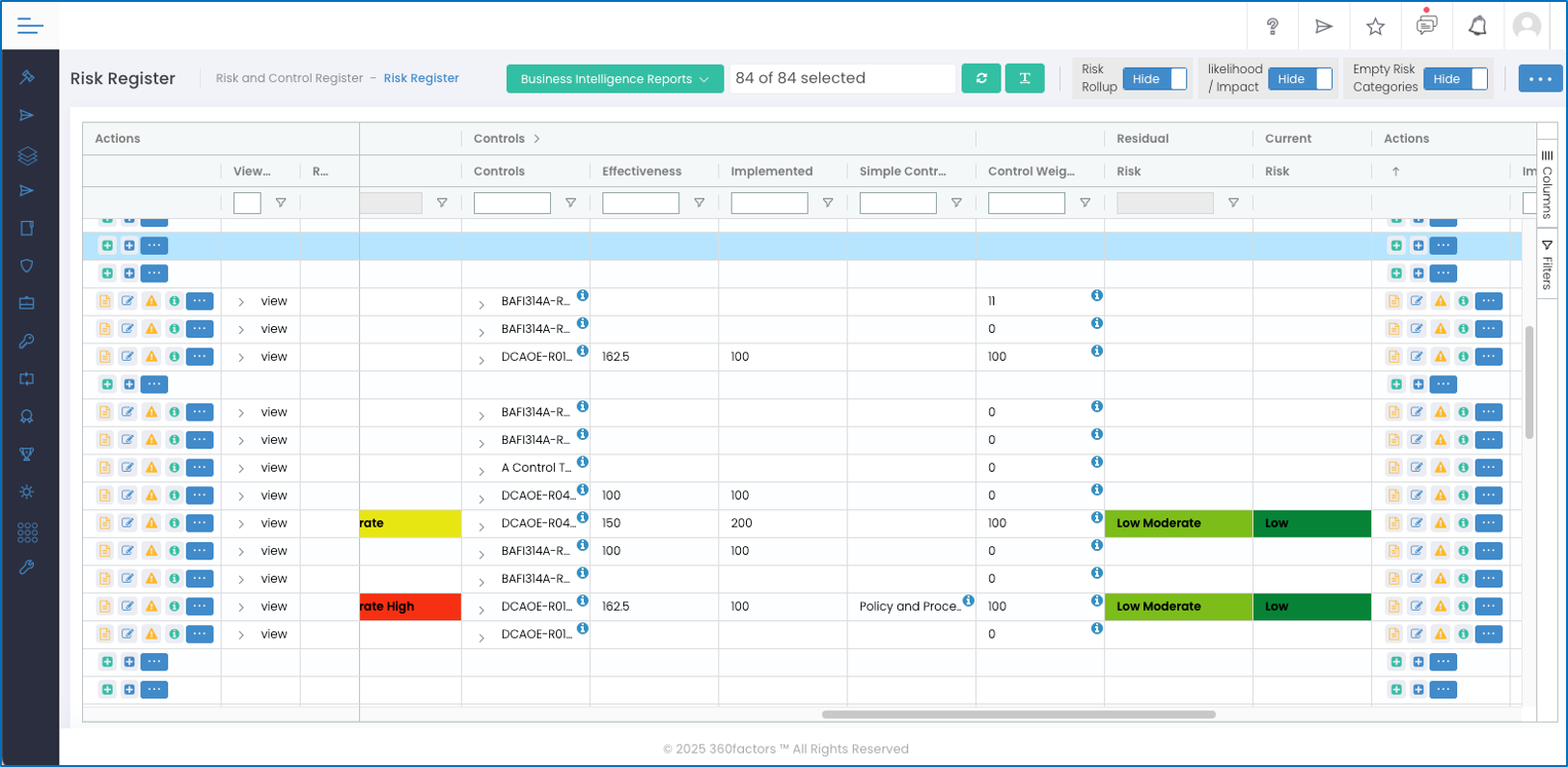
Predict360 ERM brings risks, controls, mitigation plans, and reporting into one live repository. Teams work from a shared taxonomy, new risks update across dashboards, and regulatory data feeds help them monitor emerging exposure.
Systematically identify and assess potential risks across business functions and processes.
Recognize risks from business operations, regulatory changes, and market conditions.
Maintain current risks, controls, mitigation plans, and ownership in one system.
Keep authorized stakeholders informed as risk data and metrics change.
Analyze risk data and scenarios in Power BI to support business decisions.
FEATURES
Centralize risk data, standardize assessments, automate monitoring, and give risk leaders a current view of risks, controls, issues, and mitigation activity.
Centralize risk data, controls, mitigation plans, and ownership in one repository.
Import standardized risk taxonomies to create a consistent risk library across business units.
Break down organizational silos that complicate risk management.
Distribute risk and compliance activities across the organization while maintaining centralized oversight.
Give executives enterprise-wide visibility through dashboards and risk reports.
Share compliance activities and reports across functional departments.
Integrate FRED and FFIEC data feeds to monitor market trends and emerging risks.
Track applicable requirements across Dodd-Frank, SOX, BSA/AML, HMDA, CFPB, RESPA, FATCA, FINRA 4210, fair lending, and more.
Use AI-powered regulatory analysis to help teams review and interpret new requirements.
Communicate and collaborate on risk appetite with authorized stakeholders.
CAPABILITIES
Assess, monitor, and resolve enterprise risk through connected workflows built for the work risk teams perform every week.
Store risk data in one repository and apply a consistent, importable taxonomy across business units.
Explore RCSA softwareMonitor market trends and emerging risks while reviewing supported regulatory content in context.
Explore Risk InsightsConnect risk, compliance, reporting, and issue workflows so authorized stakeholders work from consistent information.
Explore Issues ManagementBY ROLE
CHIEF RISK OFFICER
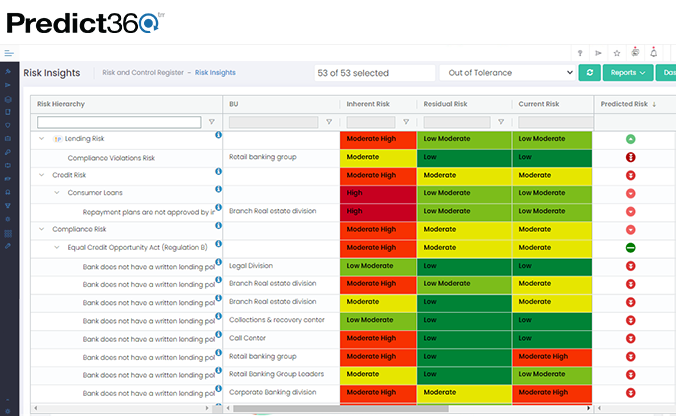
Standardize how every business unit identifies, assesses, and reports risk. Predict360 updates authorized dashboards as information changes, giving you a consistent view of inherent, residual, current, and predicted risk.
CHIEF COMPLIANCE OFFICER
Connect regulatory requirements, controls, testing, issues, and remediation in one system. Predict360 helps compliance teams coordinate work across departments while maintaining a current view of applicable obligations and evidence.
CHIEF FINANCIAL OFFICER
Use a consistent enterprise risk view to understand where exposure is increasing, where controls require attention, and how mitigation activity aligns with business priorities. Dashboards and Power BI integration support informed resource decisions.
CHALLENGES
Legacy ERM processes rely on decentralized data, manual entry, and inconsistent risk and control definitions. Teams spend more time gathering and reconciling information, while leaders wait for a reliable view of inherent, residual, current, and emerging risk.
Risk teams must coordinate regulatory compliance, incident management, investigations, internal audit, and quality management without losing ownership or context.
Regulatory changes, market shifts, operational events, and internal restructuring can increase risk exposure quickly. A connected approach helps teams identify and respond sooner.
Standardized data, continuous assessment, and current reporting help organizations adapt risk decisions as business conditions evolve.
INTEGRATIONS & CONTENT PARTNERS
Partner and integration marks are the property of their respective owners and appear here to describe interoperability only. They do not imply endorsement of any specific outcome. Content libraries are licensed separately; availability varies by plan.
EVALUATION FAQ
Answers to the enterprise risk management software questions risk, compliance, and audit leaders ask most during evaluation.
Predict360 can support a focused cloud implementation in days rather than quarters. Timing depends on the applications selected, the risk taxonomy, integrations, historical data, and review requirements. Starting with one application and a defined data set is usually the fastest path. Confirm the implementation plan with the 360factors services team.
Yes. A financial institution can begin with enterprise risk management and add other Predict360 GRC applications later. The modular platform is designed so teams can expand into RCSA, compliance, issues, audits, or related workflows without replacing the core environment. Available modules and sequencing should be confirmed for the selected plan.
Predict360 can support risk libraries and requirements associated with regulations and frameworks such as Dodd-Frank, SOX, BSA/AML, HMDA, CFPB, RESPA, FATCA, FINRA 4210, fair lending, and more. Coverage is not universal: applicable content varies by plan, institutional charter, jurisdiction, and states of operation. Confirm the exact libraries and update scope during evaluation.
Yes. Predict360 connects with external data feeds such as FRED and FFIEC and supports Microsoft Power BI for analytics and visualization. Additional integrations may be available for core banking, data warehouses, and regulatory content. Confirm supported connectors, data direction, refresh frequency, and any implementation requirements for your operating environment.
Predict360 uses enterprise-grade security and access controls to protect risk and compliance data. Specific safeguards, hosting arrangements, retention policies, and assurance documentation should be reviewed with a risk specialist during evaluation because requirements vary by institution and deployment. Request the current security package for detailed, verified information.
ERM RESOURCES
CUSTOMER VOICES

REVIEWS & RECOGNITION