Less repeat research
Reuse a maintained partner profile across due diligence, monitoring and contract reviews instead of collecting the same evidence again.

PRODUCT · THIRD-PARTY INTELLIGENCE
Automate vendor due diligence with sourced intelligence and continuous risk monitoring.
FINANCIAL INSTITUTIONS USING 360FACTORS SOLUTIONS







THIRD-PARTY INTELLIGENCE AT A GLANCE
THE PROBLEM
Third-Party evidence sits across websites, questionnaires, contracts and internal systems. Analysts repeatedly collect it, while financial, cyber and regulatory changes can go unnoticed between reviews.
WITH THIRD-PARTY INTELLIGENCE
Third-Party Risk Intelligence Agent builds and maintains a sourced profile for each vendor. It combines external intelligence with your documents and risk context, explains recommendations and monitors material changes. Your team can assess evidence, address control gaps and manage the relationship from planning through offboarding, with final decisions in human hands.
Reuse a maintained partner profile across due diligence, monitoring and contract reviews instead of collecting the same evidence again.
See where information came from, when it was retrieved and what is missing before relying on it.
Review the evidence, confidence and suggested actions behind a recommendation so your team can make an informed decision.
Bring significant changes to reviewers with context, helping them focus on events that need a response.
FEATURES
Start with a third-party’s website domain and your relationship context. Use the resulting profile to investigate risk, review recommendations and respond to changes throughout the relationship.
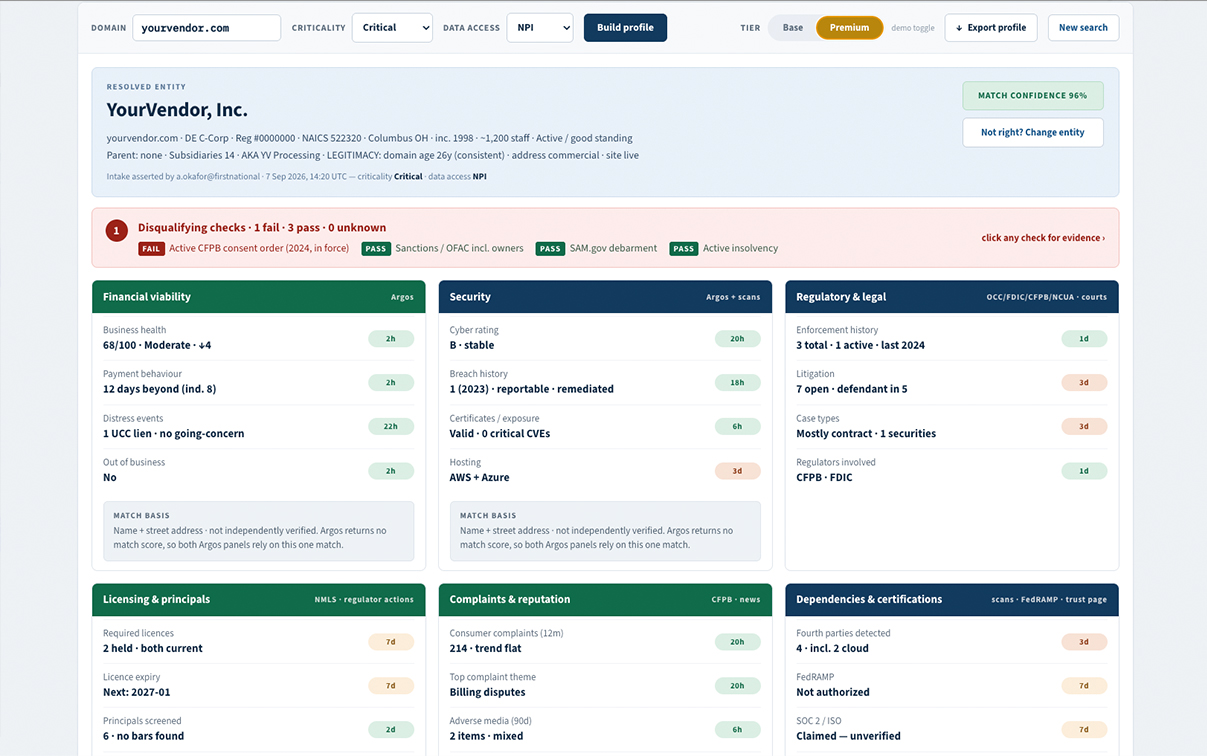
Start with a domain and confirm its legal entity to reduce duplicate records and mistaken matches.
Set relationship criticality and data access so the assessment reflects how your institution uses the vendor.
Screen sanctions, federal debarment, active enforcement and insolvency findings with links to supporting records.
Combine corporate, financial, cyber, regulatory and reputation intelligence to reduce manual research across separate sources.
See source dates, confidence and missing information so reviewers can judge whether the evidence is sufficient.
Assess recommendations with reasons, suggested controls and supporting evidence while retaining human approval.
Map evidence to your institution’s controls to identify gaps that require follow-up.
Monitor material changes and route review tasks with context to focus attention on events requiring action.
Extract contract terms and service commitments to support renewal, clause and exit reviews.
Explore shared providers and fourth-party dependencies to understand where exposure concentrates.
Track exit obligations, data return and access removal to support an orderly end to the relationship.
Retain findings, analyst decisions and documented limitations in a due-diligence record for audit and management review.
CAPABILITIES
Use one maintained profile to gather intelligence, assess recommendations and monitor the relationship. Your team keeps the evidence and reasoning behind each decision.
Bring identity, financial, cyber and regulatory evidence into one partner profile. See source dates and unavailable information so reviewers can assess the record before deciding.
Review a recommendation, its confidence and its reasons in the context of your vendor’s criticality and data access. Identify control gaps and retain your team’s decision.
Review material changes, shared-provider exposure and contract obligations. Track follow-up and offboarding evidence so oversight continues throughout the relationship.
BY ROLE
CHIEF RISK OFFICER
Review material events, high-risk partners and shared-provider dependencies across the portfolio. Recommendations include evidence and reasons, helping your team evaluate residual risk and explain its decisions to the risk committee.
Request a demoCHIEF COMPLIANCE OFFICER
Bring regulatory findings, supporting documents and your institution’s controls into the review. Source dates and missing-data indicators show the limits of the evidence, while recorded recommendations and analyst decisions support audit and examination preparation.
Request a demoINFORMATION SECURITY LEADER
Review cyber signals, breach information and fourth-party dependencies alongside the party’s data access and business criticality. Material-change monitoring helps your security and vendor teams assess which events require follow-up.
Request a demoCHALLENGES
A stored document cannot tell you what changed after it was collected. Third-Party Risk Intelligence Agent maintains partner intelligence with visible sources, retrieval dates and freshness indicators. Reviewers can see both the findings and the gaps before accepting a recommendation or requesting more evidence.
See which information is fresh, aging or stale, and inspect the underlying source. Refresh follows the available source, so your team can distinguish current signals from older documents.
Review recommendations based on both evidence and how your institution uses the relationship. Supporting reasons, confidence and control gaps help reviewers assess the suggested response.
View shared providers and fourth-party dependencies alongside portfolio concentration. Use the relationship context to assess how a vendor disruption could affect multiple activities.
Track notice periods, exit obligations, data return and removal of access. Retain transition evidence and the history so teams can document how the relationship ended.
FOR THE WHOLE TEAM
Risk analysts need reliable evidence. Vendor managers need to track material changes and obligations. Executives need a clear view of exposure. Third-Party Risk Intelligence Agent connects the profile, recommendations and decision history so each team can work from the same record.
Gather and reuse sourced intelligence instead of rebuilding the record for each assessment.
See source dates and unavailable information before deciding whether more diligence is needed.
Review material changes with supporting context and track the team’s response.
Assess recommendations using your relationship criticality, data access and control requirements.
Examine high-risk partners and shared-provider dependencies to support management discussions.
Retain recommendations, analyst rationale and exit evidence across the relationship lifecycle.
EVALUATION FAQ
Understand how the agent gathers evidence, supports decisions and maintains visibility throughout a third-party relationship.
Enter the third-party’s website domain, then select the relationship’s criticality and level of data access. The agent resolves the legal entity and flags ambiguous matches for confirmation. This context matters because the same partner can present different risks to different institutions. Your team reviews the resulting evidence and supplies additional documents where needed.
The profile brings together available corporate, financial, cyber, regulatory, complaint, licensing and reputation intelligence. It also incorporates contract, insurance, certification, commercial, environmental, social and governance, geographic and dependency information where sources or supplied documents support it. Each value carries source and date information. Missing or unavailable evidence is visible, so your team can identify what still needs to be obtained.
It reduces repeated requests where information is already available from approved sources or earlier collection. Some evidence still needs to come from the vendor or your institution, including non-public reports, contracts and internal control results. Partner-published certification claims remain distinguished from verified evidence. Your team can see these gaps and decide what additional diligence is needed.
The agent refreshes intelligence and identifies material regulatory, cyber, financial, sanctions, litigation and media changes. Significant events can trigger review tasks, with the findings and the team’s response retained in the history. Refresh rates depend on each source; visible dates and freshness indicators help reviewers assess currency. Your institution determines the oversight appropriate to the relationship.
Your institution does. The agent provides recommendations with confidence, reasons, supporting evidence and suggested actions. Your reviewers can approve, reject, request more information or escalate, and record why they overrode a recommendation. Risk assessment reflects the relationship’s criticality and data access alongside evidence. The agent supports judgment; it does not autonomously approve a third party.
It extracts contract terms such as renewal dates, service commitments, liability provisions and termination obligations for review. During offboarding, teams can track notice requirements, return or destruction of data, removal of access and transition arrangements. The record and supporting evidence remain available after termination under the applicable retention settings. Contract negotiation and business decisions remain with your team.
The agent supports delivery of intelligence to authorized institutional systems, including scheduled data feeds. This helps risk, security and third-party teams work from a shared evidence base. Discuss your systems, data sources and access requirements with a 360factors representative to establish the connection scope. Specific connectors and data-provider coverage need to be confirmed for your organization.
Third-Party Risk Intelligence Agent RESOURCES
CUSTOMER VOICES

REVIEWS & RECOGNITION