Home/ Blog / 6 Leading Enterprise Risk Management Trends in 2026
To be competitive in the uncertain landscape of the financial sector, more robust Enterprise Risk Management (ERM) systems are needed. The interconnection of risks is one component of the current risk environment that businesses must deal with daily, but this aspect often does not receive the attention it requires.
Economies throughout the globe have contended with:
- Supply chain interruptions due to tariffs
- Record inflation
- An increase in geopolitical stress
Enterprises are becoming increasingly integrated with their partners, suppliers, and vendors throughout the international marketplace. This has further accelerated digitization of communications and operations, calling for an increase in speed and accuracy from all parties involved.

One way that is majorly transforming the way that enterprises are managing risk is through investing in AI based risk management technology. Read on to understand more about the six leading enterprise risk management trends in 2026 and how they could potentially impact the way that your team manages risk.
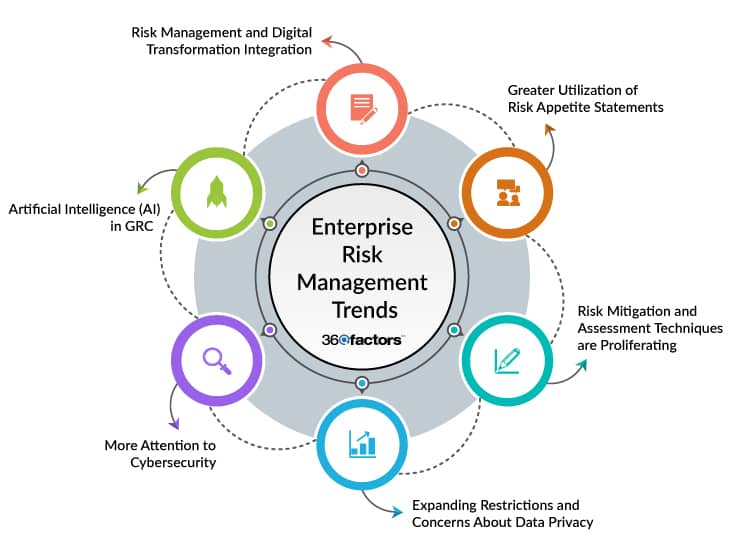
Risk Management Trends for 2026
Understanding the risk management trends for 2026 help organizations to prepare for the year ahead and stay ahead of the curve when it comes to understanding their risk profile and managing compliance with regulatory bodies.
1. Digital Transformation Integration
In PwC’s December 2025 survey only 6% of security and IT respondents reported feeling confident across all vulnerability areas in withstanding cyber-attacks. This risk management trend suggests that it is vital for managers to work with other departments in the company to detect and evaluate the influence to reduce risks as per the risk appetite of an enterprise.
An integrated governance framework such as Predict360 can assist by reconciling strategy, staff, procedures, and technological objectives throughout the value chain.nterprise risk management trend 2024, This is particularly crucial for guaranteeing the risk element is included in more extensive digital transformation strategies.
2. Greater Utilization of Risk Appetite Statements
Risk appetite statements in the financial sector serve to enhance communication with staff, regulators, and investors. A specific group of risks is needed to broaden the pool of loans, but if large numbers of borrower’s default, a bank must have a contingency plan. This includes developing a safety baseline for fraudulent or defaulted mortgage transactions, enabling them to make a profit.
In 2026 this risk management trend reflects the challenges that organizations encounter in executing a successful risk appetite statement. Certain executives may be concerned that risk appetite statements could bind their capability to pursue emerging opportunities, whereas others may be worried that poorly worded statements could be misinterpreted as overlooking unacceptable practices. For this reason, implementing effective risk management software is the best avenue to facilitate the detection of organizational risk.
3. Risk Mitigation and Assessment Techniques
The resources available for actively evaluating and managing risks are improving. Internal and external risk monitoring tools that contribute to the creation of risk intelligence (which identifies recurring and new threats) are among the risk management trends in 2026. At the close of last year, organizations were also utilizing more comprehensive tools to:
- Provide a comprehensive picture of risks affecting the entire organization
- Assign accountability for risk-mitigation measures.
- Offer managers access to actual time risk reporting to help them make informed decisions.
4. Concerns about Data Privacy
Data privacy is another key topic of discussion for those managing enterprise risks and monitoring ERM trends for 2026. Organizations have increasingly become interested in monitoring how companies deal with user data due to the increased focus on protecting user data and the continually evolving worldwide data rules.
To maintain compliance, organizations need to understand pertinent data privacy laws and introduce efficient ways to mitigate risk using AI-driven GRC tools that can handle large volumes of customer data while protecting it.
5. Attention to Cybersecurity
The cybersecurity paradigm is predicted to change in 2026 because of the significant rise in cyberattacks. Businesses are already advocating for policies like cybersecurity coverage to limit the economic damage caused by these attacks.
According to Cybersecurity Ventures statistics, the cyber insurance industry was predicted to be worth $14.8 billion by 2025 and will surpass $34 billion (about $100 per person in the US) by 2031. This suggests that enterprises need to adopt an approach that can help financial organizations recognize vulnerabilities and establish controls to find risk actors before any loss is incurred due to potential cyber-attacks.
6. Artificial Intelligence in GRC
GRC strategies are increasingly adopting AI-based Technology. Automation preserves costs for GRC experts who want to maximize compliance with the proper rules and regulations. Actual evaluation of GRC data and automated reporting has improved GRC systems by boosting operational effectiveness and lowering the costs and risks associated with manual GRC handling.
The significance of this risk management trend in 2026 can be understood by considering that organizations are consistently expanding their:
- Functional scope
- Data security
- Compliance frameworks
- Privacy regulations
This is all in the name of reducing risks that could cause financial losses and negatively influence business operations. To stay competitive, organizations must consistently improve their risk management strategies and employ surrounding vulnerabilities to pursue relevance in the coming year.
Risk management has already reached beyond compliance, and it currently serves as a strategic component that assures long-term sustainable expansion. Choosing a thriving and holistic enterprise risk management software is the golden solution to staying abreast in the financial sector.
Get in touch to learn more about AI-driven software like Predict360 ERM that can serve as a one-of-a-kind solution for all risk-related challenges. It enables corporate visibility and facilitates enterprise risk management and compliance professionals to evaluate, manage, and decrease risks.

Request a Demo
Complete the form below and our business team will be in touch to schedule a product demo.
By clicking ‘SUBMIT’ you agree to our Privacy Policy.
Stay Informed About Upcoming Webinars & Events!