Home/ Blog / The Regulatory Change Management Process for Financial Enterprises
Regulatory Change Management is the systematic approach to identifying, assessing, monitoring, and implementing changes in relevant laws, regulations, and guidelines that impact an organization’s operations.
This process is essential for ensuring a business complies with current legal standards and anticipates and prepares for future regulatory shifts. Regulatory change management solutions encompass various activities, including:
- Tracking regulatory developments
- Evaluating regulations’ impact on business processes
- Updating internal policies and procedures accordingly
Regulatory changes are inevitable and challenging. While crucial for maintaining the integrity and stability of the economic system, these changes bring a set of significant hurdles that organizations must overcome.

Regulatory Change Management Process: Challenges
Understanding these regulatory challenges is the first step toward developing an efficient regulatory change management process. Let’s delve into the main challenges that can arise:
The High Cost of Compliance
One of the most daunting challenges is the cost associated with maintaining compliance. For smaller organizations, the financial burden can be substantial. These costs are not just limited to implementing compliance programs but also encompass the ongoing expenses of maintaining these systems.
Time to Adapt
The journey towards compliance is often a marathon, not a sprint. Regulatory changes demand time to understand the new requirements, assess their impact on existing policies, improve the regulatory change management process consistently, and implement the necessary changes.
The Complexity Problem
Regulations are rarely straightforward. Their complexity and volume can be overwhelming, making it difficult for organizations to ensure they have interpreted and applied them correctly. This complexity necessitates a clear and structured approach to RCM.
Significance of Regulatory Change Management
The ability to capture and track regulatory changes that are issued by governing bodies to those organizations in the finance sector is indispensable in the current financial services landscape. Here’s a few reasons why:
| Ensuring Compliance | An effective regulatory change management process is crucial for highly regulated sectors such as finance, healthcare, and energy. |
|---|---|
| Avoiding Penalties | An effective regulatory change management solution helps organizations stay ahead of regulatory updates. |
| Staying Competitive | By staying abreast of regulatory changes, companies can adapt strategies to maintain or enhance their market position. |
Key Attributes of an Effective Regulatory Change Management Process
A structured and effective regulatory change management process is imperative in the financial world. It is the backbone of compliance programs for financial organizations striving to navigate the complex regulatory landscape efficiently and effectively.
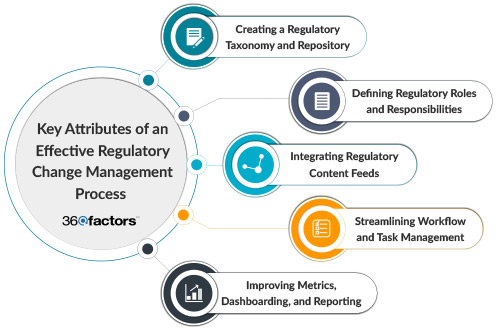
1. Establishing a Regulatory Taxonomy and Repository
The cornerstone of any proficient RCM process is the development of a comprehensive regulatory taxonomy and repository. This involves creating a catalog of regulatory areas affecting the organization and categorizing regulations to streamline management.
To ensure a smooth regulatory change management process, the taxonomy should be integrated with a repository that includes relevant regulations, providing clear links and mappings to various elements such as:
- Regulatory Associations: Including lawmakers, government agencies, and industry associations.
- Document Forms: Encompassing laws, guidelines, rules, and other regulatory documents.
- Information Sources: Identifying where regulatory information can be obtained, such as official websites and RSS feeds.
- Elements: Essential for classification, such as jurisdiction, related regulations, and the status of changes.
This structured approach ensures that regulatory information is organized, up-to-date, and easily accessible, facilitating more efficient management through the regulatory change management tool.
2. Defining Regulatory Roles and Responsibilities
An effective regulatory change management process depends on clear accountability. Ensuringght individuals within the organization is crucial.
This involves identifying subject matter experts (SMEs) for each regulatory category and subcategory who possess the requisite knowledge to assess the impact of regulatory changes on the organization. By setting roles and responsibilities, organizations can foster a culture of accountability.
3. Integrating Regulatory Content Feeds
Staying ahead of regulatory changes requires access to reliable and timely information. Organizations should establish a network of regulatory content feeds, sourcing information directly from regulators, legal firms, consultancies to improve the regulatory change management process.
4. Streamlining Workflow and Task Management
The backbone of an effective RCM process is a robust system for managing workflows and tasks. This system should facilitate the intake of regulatory changes, route them to the appropriate SMEs, and involve relevant stakeholders in the review and response process.
Ensure that tasks are completed promptly and efficiently, maintaining accountability and transparency through:
- Standardized workflows
- Task management
- Escalation mechanisms
5. Enhancing Metrics, Dashboarding, and Reporting
Organizations need comprehensive metrics, dashboards, and reporting capabilities to effectively monitor the regulatory change management process. Effective regulatory change management solutions provide insights, showcasing recent changes, status of reviews, and the overall impact on the organization.
By tracking these metrics, organizations can gauge the effectiveness of their RCM process, identify areas for improvement, and ensure that they remain compliant with all relevant regulations.
Advantages of a Regulatory Change Process
Organizations that cultivate a sophisticated RCM process stand to gain significantly across various dimensions of their operations. Let’s explore the multifaceted benefits that a streamlined RCM process brings to the table.
Elevating Organizational Effectiveness
Enhanced organizational effectiveness is a major advantage of a refined regulatory change management process. This encompasses:
- Comprehensive Regulatory Insight: Achieves a deeper understanding of evolving regulatory landscapes and their implications on the organization.
- Proactive Compliance Posture: Enables the organization to anticipate, interpret, and navigate regulatory changes efficiently, ensuring ongoing compliance and demonstrating a commitment to regulatory excellence.
Boosting Operational Efficiency
Efficiency is the lifeblood of any thriving organization. A robust RCM process contributes to:
- Resource Optimization: Streamlines the use of human and financial resources, ensuring that regulatory changes are managed without unnecessary expenditure or waste.
- Sustainable Resource Management: Facilitates a balanced resource allocation that supports current compliance needs and future regulatory evolutions.
Cultivating Organizational Agility
In today’s fast-paced business world, agility is a critical competitive differentiator. An effective regulatory change management process empowers organizations with:
- Dynamic Adaptability: Fosters a culture that embraces change, allowing the organization to pivot and adapt swiftly to new regulatory demands.
- Strategic Competitive Advantage: Equips the organization with the foresight and flexibility to navigate regulatory changes more effectively than competitors, turning potential challenges into strategic opportunities.
Integrate RCM Software to Modernize Your Process
Integrating advanced Regulatory Change Management Software like Predict360 RCM software can transform the traditional RCM process into a streamlined, efficient, and proactive operation. Predict360 platform offers comprehensive features to enhance every facet of the regulatory change management process.
This integration ensures that businesses are always in sync with the latest regulatory changes, enabling them to respond swiftly and effectively. Key features of the Predict360 RCM tool are outlined here:
| Predict360 Feature | Description |
|---|---|
| Regulatory Tracking | Streamlines regulatory change tracking through automated updates and notifications, ensuring organizations stay aware of latest regulatory developments and remain ahead of compliance requirements. |
| Automated Impact Assessments | Automates preliminary assessment of regulatory changes, identifies affected business units, and maps potential impacts based on risk assessments to enhance the regulatory change management process. |
| Management Tools | Offers project plans that track and manage multiple tasks simultaneously, integrates regulatory intelligence feeds, and aids efficient management of regulatory examinations and findings. |
| Streamlined Communication | Keeps stakeholders informed about audits, policies, rules, and documents affected by regulatory changes, ensuring organizational alignment and responsiveness across all departments. |
| Executive Oversight | Provides an executive dashboard with panoramic view of regulatory issues, enabling top-level management to make informed decisions and prioritize actions based on regulatory mandates and compliance data. |
Get in touch with our team or request a demo for a hands-on learning experience with Predict360 and Ask Kaia.

Request a Demo
Complete the form below and our business team will be in touch to schedule a product demo.
By clicking ‘SUBMIT’ you agree to our Privacy Policy.
Stay Informed About Upcoming Webinars & Events!