
Financial institutions and other regulated organizations manage a steady flow of regulatory updates. When teams rely on spreadsheets and email threads to track change, it becomes harder to maintain consistent documentation, meet internal deadlines, and demonstrate a clear audit trail.
A regulatory change management (RCM) solution can help centralize intake, triage, impact assessment, and follow-through. Platforms vary in how they source regulatory content, how they support impact analysis, and how well they connect change activities to policies, controls, issues, and reporting.
Download our free RCM solution evaluation checklist
Get the Checklist
Below are three RCM solutions to consider, with a short view of where each tends to fit.
| Solution | Best For | AI Capabilities | Regulatory Intelligence |
|---|---|---|---|
| Predict360 | Banks, credit unions, and financial institutions needing end-to-end RCM with embedded AI | Kaia AI companion trained on U.S. banking regulations; automated impact analysis; policy drafting and review | Real-time regulatory feed from multiple agencies; AI-parsed updates with applicability analysis |
| CUBE RegPlatform | Global enterprises requiring automated regulatory intelligence at scale | RegBrain AI engine for automated horizon scanning and regulatory mapping – can integrate regulatory intelligence with Predict360 | 800+ regulatory sources globally; 250+ regulatory SMEs curating content |
| MetricStream | Large enterprises needing a full GRC suite with regulatory content lifecycle management | AiSPIRE for predictive risk identification, duplicate control detection, and cognitive recommendations | 750+ legislative and regulatory authorities worldwide |
1. Predict360
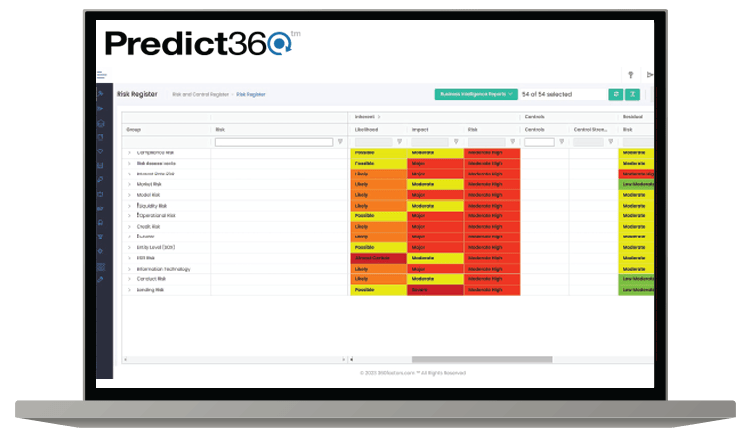
Predict360 is a risk and compliance intelligence platform designed for banks, credit unions, and other financial institutions. Its Regulatory Change Management module is positioned as a single place to monitor regulatory updates, assess potential impact, manage remediation work, and report on progress.
Predict360 highlights Ask Kaia, an embedded AI companion intended to support regulatory Q&A and drafting inside the platform. For teams evaluating AI assistance, confirm the underlying content sources, model guardrails, and how outputs are reviewed and approved before use in policies or procedures.
Key Features
- Regulatory update intake and routing, including filtering by applicability and business relevance.
- Impact analysis workflows that connect changes to business units, policies, controls, and risk categories.
- Policy and document management workflows, including review cycles and evidence retention.
- Task and project management to track remediation activities, owners, and due dates.
- Executive reporting and audit-ready traceability.
Why It Stands Out
Its domain-specific AI and tight integration of regulatory change with risk, compliance monitoring, and audit workflows give banks a single, connected system instead of scattered tools that is scalable and quicker to implement than most other tools in the same space.
2. CUBE RegPlatform
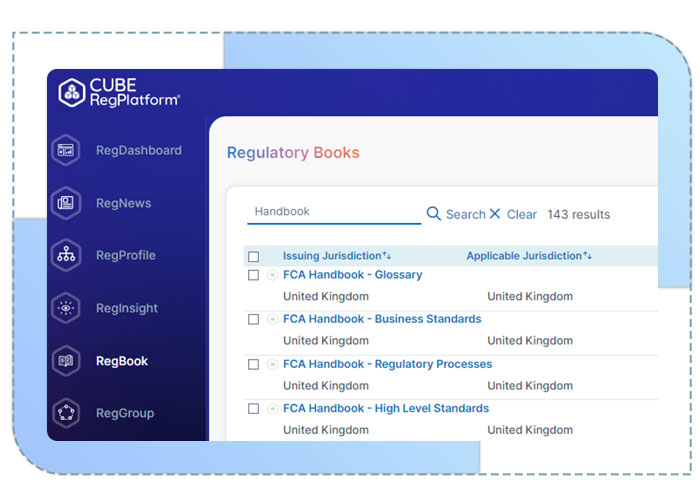
CUBE focuses on automated regulatory intelligence for organizations dealing with change across multiple jurisdictions. The platform is positioned to help teams scan for updates, classify and map regulatory content, and route relevant information into downstream workflows.
CUBE also emphasizes SME involvement to validate outputs. If you operate across regions, ask how coverage is defined, how quickly updates are published after release, and how your team can tune relevance to reduce noise.
Key Features
- Horizon scanning across global regulators, government bodies, and enforcement sources.
- Classification and mapping of regulatory content to internal policies, procedures, and controls.
- Obligations management to convert regulatory text into trackable requirements.
- Dashboards, alerts, and prioritization to focus on high-impact updates.
- Integration options for GRC, workflow, or case management systems.
Why It Stands Out
It is particularly compelling for large, global financial institutions that need consistent regulatory intelligence across regions. It typically serves as the regulatory backbone feeding intelligence into existing GRC, workflow, or case management systems, rather than replacing them outright.
3. MetricStream
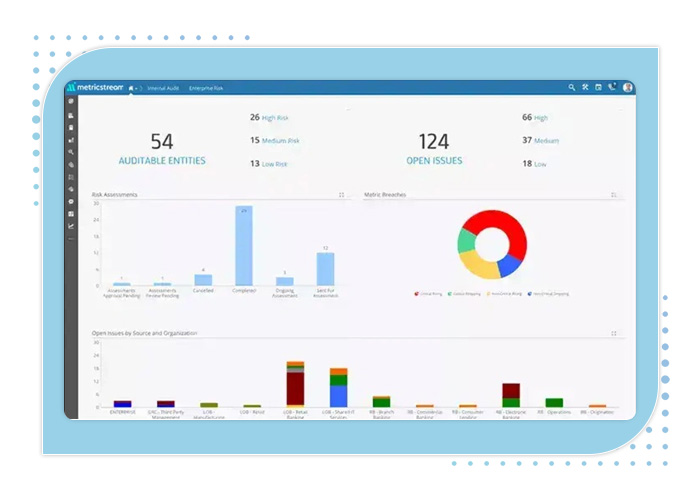
MetricStream offers an enterprise GRC platform that includes regulatory change management alongside risk, audit, and compliance modules. It is typically considered by organizations that want a broad suite and have the resources to implement and govern it.
MetricStream describes AI-enabled analytics and recommendations within its platform. When evaluating, clarify what is automated versus assisted, what configuration is required, and how teams maintain oversight of regulatory interpretations and control decisions.
Key Features
- Regulatory change monitoring across legislative and regulatory authorities.
- Obligation extraction and tracking from source content through remediation.
- Workflow for action plans, assignments, approvals, and accountability.
- Reporting for visibility into open items, deadlines, and evidence.
- Integrations with regulatory content providers and internal systems.
Why It Stands Out
MetricStream’s integration of regulatory change with the full enterprise GRC stack provides a holistic view. The trade-off is complexity and cost: pricing starts at approximately $75,000/year for small enterprises and can exceed $1 million for large deployments, plus implementation fees. This makes MetricStream best suited for large enterprises with dedicated GRC teams and budgets.
Frequently Asked Questions
What is regulatory change management software?
Regulatory change management (RCM) software helps organizations identify, analyze, and implement responses to new or updated laws, regulations, and standards that affect business operations. These tools automate monitoring of regulatory sources, classify relevant updates, assess impacts on policies and controls, and orchestrate workflows to close gaps while maintaining a defensible audit trail.
Why do financial institutions need a dedicated RCM solution?
Financial institutions face a high volume of regulatory changes from multiple agencies, often simultaneously. A dedicated RCM solution centralizes regulatory intelligence, automates impact assessment and workflows, and provides the traceability regulators increasingly expect.
What’s the difference between regulatory change management and compliance management?
Compliance management is the broader discipline of ensuring an organization meets applicable requirements on an ongoing basis, including internal policy adherence. Regulatory change management is a focused subset that deals with identifying and operationalizing new or updated external requirements as they emerge.
Interested in learning more about Predict360? Request a demo or speak to our team about a custom regulatory change management solution.
Download Our Free Resource
Please fill out the form to download the checklist.
By clicking ‘SUBMIT’ you agree to our
Privacy Policy.
The Predict360 Compliance Management Suite modernizes compliance monitoring, regulatory change management and document management.
Request Demo- Activity Management
- Document Management
- Compliance Monitoring
- Integrated Platform