
By 2026, the adoption of AI in the insurance industry has moved decisively beyond experimentation into operational deployment at scale. Integrating AI technologies in insurance operations continues to reshape the sector. That transformation has intensified the regulatory response, as state and federal bodies work to ensure innovation operates within legal and ethical boundaries.
The insurance industry’s shift toward AI and machine learning (ML) in the United States is now well-documented. According to a 2025 Conning survey, 90% of insurers are somewhere on the generative AI journey, with 55% in early or full deployment and ML adoption reaching 74% industry-wide. As AI’s footprint in insurance deepens, so does the importance of understanding its implications for regulatory compliance and ethical governance.
In the sections below, we examine the current state of AI in insurance, the evolving regulatory landscape through mid-2026, and the strategies insurance companies should adopt to manage compliance in this dynamic environment.
See our complimentary regulatory CMS evaluation checklist to learn more.

AI in Insurance
The regulatory landscape is shifting rapidly due to AI technological advancements. Regulatory bodies are now more focused than ever on ensuring that the deployment of AI in the insurance industry aligns with legal and ethical standards, safeguarding consumer interests while promoting innovation.
According to the NAIC’s most recent survey data, 88% of private passenger auto insurers and 70% of homeowners’ insurance companies report that they use, plan to use, or are exploring AI and ML in their operations. The global AI-in-insurance market was valued at approximately $10.36 billion in 2025 and is projected to reach $13.45 billion in 2026, according to Fortune Business Insights.
AI’s application is most prominent in claims processing followed closely by:
- Underwriting
- Fraud detection
- Pricing
- Loss prevention
Underwriting timelines have compressed from three days to three minutes at leading carriers, straight-through claims processing rates have risen from roughly 10–15% to 70–90%, and fraud detection accuracy has improved by over 30%. Claims automation is delivering resolution timelines that are 75% faster and 30–40% in cost reductions.
Regulatory Response to AI Advancements
As AI’s footprint in insurance expands, regulatory bodies have moved from observation to active governance. The National Association of Insurance Commissioners (NAIC) has led this effort, building on the framework established by its December 2023 AI Model Bulletin and accelerating new initiatives through 2025 and into 2026.
The NAIC AI Model Bulletin: From Guidance to Broad Adoption
The AI Model Bulletin established a principles-based framework for responsible AI use in insurance. It does not create new law, but it provides authoritative guidance that decisions impacting consumers must comply with all applicable insurance laws and regulations, including those governing unfair trade practices.
By early 2026, the bulletin had achieved significant traction: at least 24 states and the District of Columbia have adopted the model bulletin or substantially equivalent guidance. Notable 2025 adoptions include Delaware (Bulletin No. 148, February 2025) and Hawaii (Insurance Commissioner Memorandum No. 2025-13A, December 2025). The NAIC stated in December 2025 that over half of all states have now aligned with the bulletin’s framework.
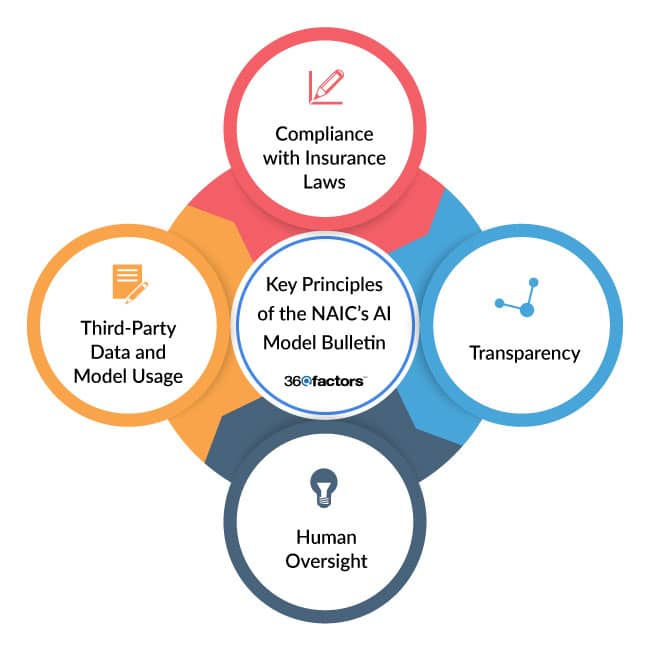
Key Principles of the NAIC’s AI Model Bulletin
Compliance with Insurance Laws
AI systems must adhere to all applicable insurance laws, ensuring fair and ethical treatment of consumers.
Transparency
There is an emphasis on the transparency of AI decisions and outcomes, and making them understandable to impacted consumers.
Human Oversight
The bulletin advocates for human involvement in AI decision-making processes, ensuring that technology complements rather than replaces human judgment.
Third-Party Data and Model Usage
Insurers using third-party services, data, and models must ensure these external resources comply with the same standards expected of the insurers themselves.
New Developments: AI Systems Evaluation Tool and Model Law
In January 2026, the NAIC launched a multistate pilot of an AI Systems Evaluation Tool. This is a structured framework designed to give insurance examiners the capability to assess AI systems during regulatory examinations.
Twelve states are participating in the pilot through September 2026, including Colorado, Maryland, California, Connecticut, Florida, Pennsylvania, and Virginia. Formal adoption of the tool is anticipated at the 2026 Fall National Meeting.
Separately, the NAIC Big Data and AI Working Group issued a Request for Information in 2025 regarding a potential Model Law on the Use of Artificial Intelligence in the Insurance Industry. This would represent a significant escalation from guidance-based regulation to codified statutory requirements.
In March 2026, the NAIC published an Issue Brief formally opposing federal pre-emption of state-based AI oversight, supporting the McCarran-Ferguson framework and affirming that state insurance regulators are the appropriate authority for governing insurers’ AI use.
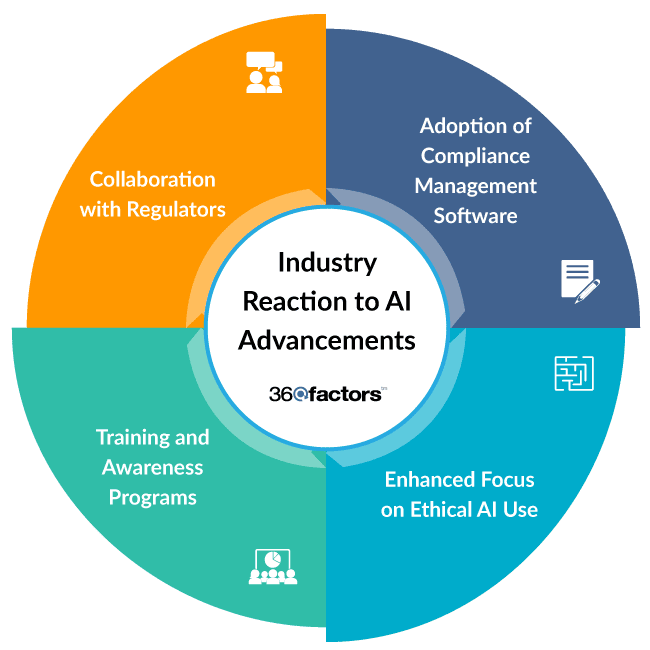
Industry Reaction
- Adoption of Compliance Management Software
Many insurers are turning to regulatory compliance management platforms to handle the complexity of adhering to overlapping state-level AI guidance and emerging model laws. - Enhancedthical AI Use
There is an increased emphasis on developing AI systems that are unbiased and auditable, with insurers investing in bias testing, model documentation, and third-party validation practices. - Collaboration with Regulators
Insurers are engaging more proactively with regulatory bodies to help shape workable compliance frameworks. - Training and Awareness Programs
Companies are implementing training programs to prepare compliance, legal, and technology teams to operate within AI governance structures and respond to regulator inquiries.
Tactics for Insurance Companies to Manage Regulatory Challenges in 2026
As AI in the insurance industry matures, managing the regulatory response requires both strategic foresight and operational infrastructure. The following tactics are relevant for 2026 and beyond.
1. Enhanced Oversight of Third-Party Providers
Insurers need to rigorously oversee third-party data providers and AI vendors. This includes ensuring that their AI systems and models comply with state laws and regulations and maintaining documentation sufficient to demonstrate that compliance to regulators.
2. Building Robust Governance Structures
Insurance companies should build governance structures that incorporate policy, defined personnel roles, monitoring, and testing for all AI deployments. This includes conducting impact and risk assessments, maintaining AI system inventories, and integrating third-party privacy and vendor management programs.
3. Ensuring Transparency and Explainability
Insurers must be able to explain how their models are built, how they function, and how they perform over time. State requirements such as Colorado’s mandate that carriers provide plain-language disclosures to consumers about AI use and maintain ongoing bias testing results as part of their compliance record.
4. Preparation for Rapid Regulatory Notification
Insurers should maintain systems that enable prompt notification of regulators in required circumstances. Regulatory notification timelines vary by state and are likely to become more specific as model law frameworks take shape in 2026.
5. Leverage Regulatory Technology
Adopting an effective regulatory technology platform that integrates AI-driven compliance workflows is one of the most practical responses to a multi-state, fast-moving regulatory environment.
Predict360’s Regulatory Change Management (RCM) software, developed by 360factors, is one example of how insurers address these requirements operationally. Its key capabilities include:
- Regulatory Intelligence and Updates
- Automated Impact Assessment
- Integrated Regulatory Intelligence Feeds
- Automated Notifications
- Real-Time Executive View
By mid-2026, the relationship between AI and insurance regulation has matured considerably. What began as guidance-based frameworks in 2023 is evolving into enforceable state regulations, multi-state examination tools, and anticipated model legislation.
The Predict360 Enterprise Risk Management Software ensures managers have complete visibility of enterprise risk on a single dashboard.
Request Demo- Cloud-Based
- Risk Repository
- Assess Risks
- Real-time Monitoring