
Home/ Blog / Top Risks in 2026 Shaping Risk Management in Insurance
What’s emerging in 2026 is a clear shift in the risk landscape: from traditional actuarial and operational concerns to broader, more complex risks that span cybersecurity, macroeconomic instability, and internal infrastructure limitations.
For insurance companies, this shift demands more than periodic risk reviews or manual mitigation efforts can offer. It requires rethinking how risks are identified, assessed, and acted upon. Therefore, legacy systems and siloed processes are being replaced by agile, real-time frameworks that enable faster decisions.

Read on to understand the ten most pressing risks shaping the insurance sector in 2026 and how smarter risk management software can empower insurers to navigate uncertainty more confidently.
2026’s Most Pressing Risks for Insurance Companies
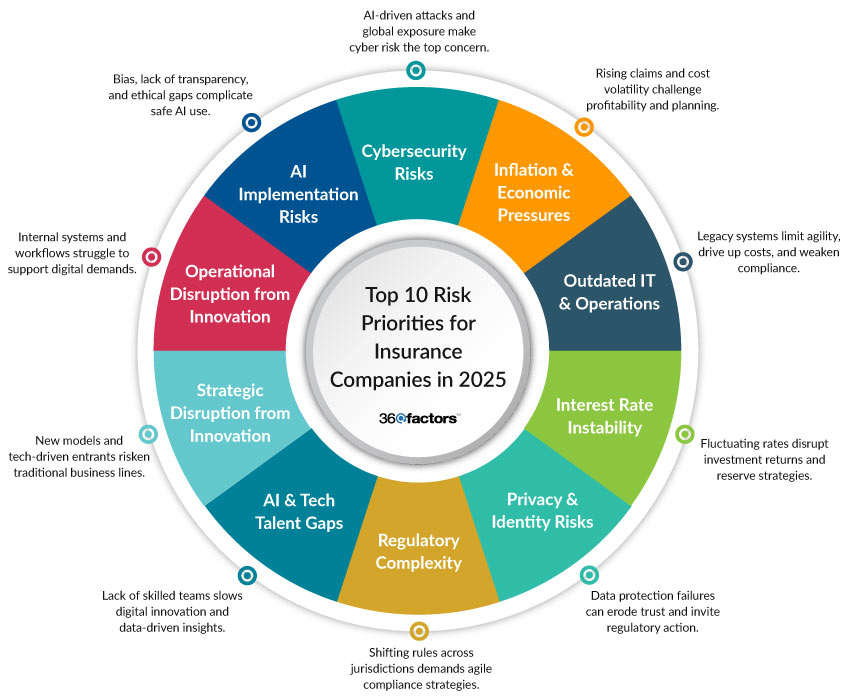
1. Cybersecurity Risks
Cybersecurity remains the most significant operational threat facing insurers in 2026. However, the nature of cyber risk has evolved beyond isolated breaches. Attacks are increasingly systemic, targeting interconnected supply chains, cloud infrastructure, and third-party service providers.
Many insurers are establishing centralized cyber intelligence teams and enhancing real-time threat monitoring. Still, challenges remain around cyber risk modeling, underwriting accuracy, and visibility across complex digital ecosystems.
2. Economic Conditions and Inflation
Economic uncertainty continues to influence insurance profitability and capital planning in 2026. Although inflation has moderated in some markets, cost volatility remains a major concern for insurers. Higher repair costs, medical expenses, labor shortages, and supply chain disruptions are driving increased claims payouts.
At the same time, global economic instability and shifting monetary policies are introducing uncertainty into investment portfolios and capital allocation strategies.
For insurers, effective risk management now requires more sophisticated forecasting models, dynamic pricing strategies, and stress testing capabilities. Organizations that fail to accurately anticipate inflationary pressures may experience reserve shortfalls and margin erosion.
3. Legacy IT and Operational Infrastructure
Outdated technology infrastructure remains a major obstacle for insurers attempting to modernize their operations. Many organizations still rely on legacy policy administration and claims systems that were built decades ago.
These systems limit automation, slow regulatory reporting, and make it difficult to integrate new digital technologies such as AI-driven analytics and real-time underwriting tools. As insurers accelerate digital transformation initiatives, the challenge of managing technical debt becomes more urgent.
Legacy infrastructure also increases exposure to cybersecurity vulnerabilities and operational disruptions. Insurers that fail to modernize risk losing competitiveness against organizations that leverage modern cloud platforms and data-driven decision-making.
4. Interest Rate Volatility
Interest rate fluctuations continue to affect insurers’ investment strategies and product profitability, particularly for life insurers and annuity providers.
The table below illustrates how interest rate volatility affects different aspects of insurance operations:
| Area | Impact |
|---|---|
| Product Pricing | Long-term guarantees become more difficult to price accurately |
| Asset-Liability Management | Investment returns may not match policy obligations |
| Portfolio Stability | Asset values fluctuate with changing market conditions |
| Capital Adequacy | Insurers must maintain stronger capital buffers |
5. Privacy and Identity Protection
Insurers are collecting and processing unprecedented volumes of customer data. This growth in data usage increases exposure to:
- Privacy risks
- Identity theft
- Regulatory penalties
At the same time, global privacy regulations are becoming more stringent, requiring insurers to demonstrate stronger governance over how customer information is collected, stored, and used.
Customers increasingly expect insurers to demonstrate transparency, accountability, and responsible data stewardship. A single privacy breach can result in significant financial penalties and long-term reputational damage.
6. Regulatory Uncertainty and Scrutiny
Traditional compliance approaches based on periodic reviews are no longer sufficient. Insurers must now implement continuous regulatory monitoring and automated compliance processes to keep pace with evolving requirements.
The challenge lies in dynamically monitoring regulatory shifts and operationalizing compliance at scale. The ability to interpret legal changes, assess policy impact, and communicate with stakeholders is becoming a strategic differentiator in regulatory risk management.
7. AI and Tech Talent Shortage
Competition for data scientists, machine learning engineers, and AI governance specialists has intensified across industries. Without the necessary expertise, insurers may struggle to successfully deploy AI initiatives or effectively manage the associated risks.
The talent shortage also introduces governance challenges. As regulators place greater emphasis on algorithm transparency and accountability, insurers must ensure they have the internal capabilities to validate, audit, and monitor AI models.
Forward-looking insurance organizations are addressing this challenge through:
- Workforce development
- Strategic partnerships
- Stronger AI governance frameworks
8. Disruptive Innovation and Market Shifts – Strategic
Embedded insurance, digital platforms, and ecosystem partnerships are redefining how insurance products are distributed and consumed. Insurtech startups and technology companies are raising expectations for speed, personalization, and digital experiences.
Customers increasingly expect insurance products to be integrated seamlessly into their everyday digital interactions. For traditional insurers, the strategic risk lies in failing to adapt quickly enough to these evolving market dynamics.
9. Operational Risk from Continuous Transformation
Digital transformation projects often reveal inefficiencies in legacy processes. However, implementing new technologies without adequate operational readiness can create disruptions across underwriting, claims management, and customer service operations.
To manage these risks, insurers must align transformation initiatives with robust operational risk management practices. This includes improving cross-functional collaboration, strengthening change management processes, and ensuring that technology upgrades are supported by appropriate governance frameworks.
10. Risks from Implementing AI
AI systems are now being used in the insurance industry for underwriting, claims processing, fraud detection, and customer interactions. While these technologies offer significant efficiency gains, they also introduce risks.
Successfully managing AI risk will require a combination of technical oversight, governance structures, and ongoing monitoring to ensure that innovation does not compromise trust or regulatory compliance.
Implementing a Strategic Risk Management Strategy
Siloed systems, fragmented data, and manual tracking no longer offer the responsiveness or scale needed to address today’s challenges. A unified strategy of risk management in insurance is necessary when dealing with aspects like cybersecurity risks or regulatory change.
Modern risk operations must be built on real-time visibility. This means integrating risk data across functions, aligning risk appetite with business decisions, and enabling faster detection through embedded intelligence and automation.
Integrating Insurance Risk Management Software
Risk management in 2026 requires more than traditional oversight. Insurers must move toward intelligent, integrated solutions that provide real-time visibility and cross-functional collaboration.
This is where Predict360 Insurance Risk Management Software offers a strategic advantage. It provides specialized risk management modules tailored for insurance companies, enabling them to identify emerging risks early and take proactive steps to mitigate potential issues.
Here’s how the enterprise risk management module supports insurers in managing the top 10 risks of 2026:
| 2026 Risk to Insurers | Predict360 Capability |
|---|---|
| Cybersecurity Risks | Real-time monitoring, centralized dashboards, and risk data integration |
| Economic Conditions & Inflation | Integration with Power BI for scenario analysis and visualization of financial exposures |
| Legacy IT Infrastructure | Cloud-native, modular design that supports system modernization |
| Interest Rate Volatility | Centralized risk repositories and automated updates |
| Privacy & Identity Protection | Regulatory coverage (e.g., SOX, FATCA, BSA/AML) and automated documentation |
| Regulatory Uncertainty | AI-assisted interpretation of legal language and dynamic risk libraries |
| AI and Tech Talent Shortage | Intuitive AI companion Kaia |
| Strategic Disruption | Standardized risk taxonomies for the insurance sector |
| Operational Disruption | Cross-functional collaboration tools and centralized oversight |
| AI Implementation Risks | Real-time visibility, structured risk assessments, and automated controls |
Get in touch with our team about a custom solution or request a demo of Predict360 or our Ask Kaia AI assistant today.

Request a Demo
Complete the form below and our business team will be in touch to schedule a product demo.
By clicking ‘SUBMIT’ you agree to our Privacy Policy.
Stay Informed About Upcoming Webinars & Events!