Home/ Blog / Five Steps of the Risk Management Process
The risk management process is a framework for the actions that need to be taken to keep an organization safe from threats beyond their risk appetite. There are five basic steps that are taken to manage risk.
The process begins with identifying risks, goes on to analyze risks, then the risk is prioritized, a solution is implemented, and finally, the risk is monitored. In manual systems, as opposed to when GRC technology is integrated, each step involves a lot of documentation and administration.
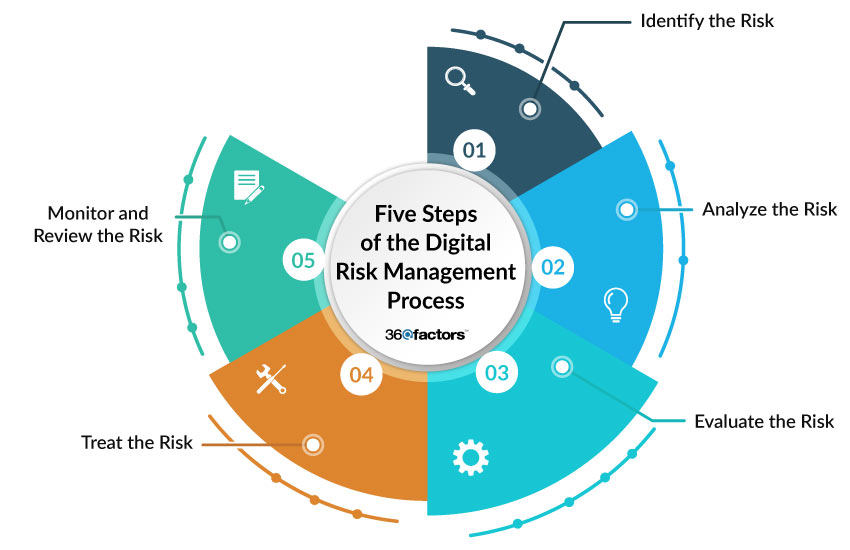
These are the five steps your team needs to take during the risk management process:
- Identify the Risk
- Analyze the Risk
- Evaluate or Rank the Risk
- Treat the Risk
- Monitor and Review the Risk
Step 1: Identify the Risk
The initial step in the risk management process is to identify the risks that the business is exposed to in its operating environment.
There are many different types of risks:
- Legal risks
- Environmental risks
- Market risks
- Regulatory risks etc.
It is important to identify as many of these risk factors as possible. In a manual environment, these risks are noted down manually. If the organization has risk management solutions in place, all this information can be directly inserted into the system. The advantage of this approach is that these risks are now visible to every stakeholder in the organization with access to the system.
The advantage of this approach is that these risks are now visible to every stakeholder in the organization with access to the system. Instead of this vital information being locked away in a report which must be requested via email, anyone who wants to see which risks have been identified can access the information in the risk management system.
Step 2: Analyze the Risk
Once a risk has been identified it needs to be analyzed. The scope of the risk must be determined. It is also important to understand the link between the risk and different factors within the organization.
To determine the severity and seriousness of the risk it is necessary to see how many operational functions the risk affects. There are risks that can bring the whole business to a standstill if actualized, while there are risks that will only be minor inconveniences in the analysis.
In a manual risk management environment, this analysis is done at a slower pace than when a risk management solution is implemented. Using this system to map risks to different documents, policies, procedures, and business processes means you will already have a risk management framework to help you evaluate risks the effects of each risk.
Step 3: Evaluate the Risk or Risk Assessment
Risks need to be ranked and prioritized. Most risk management solutions have different categories of risks, depending on their severity. For example, a risk that may cause some inconvenience is rated ‘low’, while risks that can result in catastrophic loss are rated the highest.
It is important to rank risks because it allows the organization to gain a holistic view of the risk exposure of the whole organization. The business may be vulnerable to several low-level risks, but it may not require upper management intervention. On the other hand, just one of the highest-rated risks is enough to require immediate intervention.
There are two types of risk assessments:
Qualitative Risk Assessment
Many risk assessments are inherently qualitative. This is because, while we can derive metrics from the risks, most risks are not quantifiable. For instance, the risk of climate change that many businesses are now focusing on cannot be quantified as a whole; only different aspects of it can be quantified.
For this reason, there needs to be a way to perform qualitative risk assessments while still ensuring objectivity and standardization in the assessments across business units.
Quantitative Risk Assessment
Finance-related risks are best assessed through quantitative risk assessments. Such risk assessments are common in the financial sector because the sector primarily deals in numbers. This includes money, metrics, interest rates, or any other data points critical for risk assessments.
Quantitative risk assessments are easier to automate than qualitative risk assessments and are generally considered more objective. Go in more depth on this topic in our article, “Bringing Quantitative Risk Analysis to Enterprise Risk Management”.
Step 4: Treat the Risk
Every risk needs to be eliminated or contained as much as possible. This is done by connecting with the experts of the field to which the risk belongs. In a manual environment, this entails contacting every stakeholder and then setting up meetings so everyone can talk and discuss the issues.
The problem is that the discussion is broken into many different email threads, across different documents and spreadsheets, and many different phone calls.
In a risk management solution, all relevant stakeholders can be sent notifications from within the system. Discussion regarding the risk and its possible solution can take place within the system.
Upper management can also keep a close eye on the solutions being suggested and the progress being made within the system. Instead of everyone contacting each other to get updates, everyone can get updates directly from within the risk management solution.
Check our post “Improving Risk and Compliance Results With Smarter Data” for further information on this topic.
Step 5: Monitor and Review the Risk
Not all risks can be eliminated, and it is inevitable that some risks will always be present. Market risks and environmental risks are just two examples of risks that always need to be monitored.
Under manual systems, monitoring happens through diligent employees. These professionals must ensure they keep a close watch on all risk factors. In a digital environment, the risk management system monitors the entire risk management framework of the organization, immediately alerting teams to any risk changes with less room for human error.
Risk Management Evaluation
Any business that wants to maximize its risk management efficiency needs to focus on risk management evaluations. These evaluations and assessments help businesses truly understand their own capabilities, strengths, and vulnerabilities.
It can be difficult to carry out these evaluations manually, but risk management solutions and technology can simplify the evaluation and assessment workflow. It is important to do an evaluation before making any major changes to the risk management framework. See the difference in the process below:
| Aspect | Manual Process | GRC Technology-Enabled |
|---|---|---|
| Risk Identification | Documented manually via spreadsheets, emails, and paper forms | Risks logged directly into a centralized system |
| Risk Analysis | Time intensive to map risks to business processes, policies, and procedures | Automated risk mapping framework evaluates interconnections and far-reaching effects instantly |
| Risk Ranking | Holistic view is difficult to achieve with manual categorization | System automatically ranks and prioritizes risks by severity |
| Collaboration | Fragmented across email threads, documents, phone calls, and meetings; difficult to track discussions | Discussions and solutions are documented in one place; management monitors progress in real time |
| Monitoring | Dependent on diligent employees manually tracking risk factors; prone to human error | Continuous automated monitoring; immediate alerts when risk factors change |
| Documentation | Heavy administrative burden; information locked in reports requiring email requests | Centralized repository with audit trails; instant access to historical data and documentation |
| Scalability | Becomes unmanageable as organization grows; resource-intensive | Scales efficiently; handles increasing risk volumes without proportional staff increases |
| Reporting | Time-consuming to compile; reports often outdated | Real-time dashboards and automated reporting |
| Regulatory Compliance | Manual tracking of regulatory changes; audit preparation labor-intensive | Automated compliance tracking; streamlined audit evidence collection and reporting |
Common Risk Management Mistakes
While putting together your risk management process, your team will likely encounter some roadblocks. Here are a few of the common mistakes to try and avoid:
- Not identifying risks proactively
- Inadequate or inconsistent risk assessments
- Not having a clear risk management strategy
- Relying on manual processes alone
- Poor communication between business units
- A lack of transparency with stakeholders
- Failure to continuously monitor and re-classify risks
- Not staying informed about regulatory changes
Lastly, no risk management process makes a real difference if your risk appetite is not aligned correctly with your organization’s actual level of exposure.
Emerging Risk Categories to Be Aware Of
There are certain risk categories that will become more prevalent in 2026, escalating certain risk categories. Some of the most important emerging concerns include:
- Cyber security risks
- Geopolitical instability
- Supply chain interruptions (due to tariff unpredictability, labor shortages)
- Possible talent shortages
- ESG compliance challenges
- Macroeconomic instability (global debt, interest rate volatility)
Risk is not limited to these categories but many of the concerns for 2026 are correlate with those listed above.
Managing Risks Effectively
Scroll through our frequently asked questions to understand more about the risk management process.
What is Risk Management?
Risk management is an important business practice that helps businesses identify, evaluate, track, and improve the risk mitigation process in the business environment. Risk management is practiced by businesses of all sizes; small businesses do it informally, while enterprises codify it.
Businesses want to ensure stability as they grow. Managing the risks that are affecting the business is a critical part of this stability. Not knowing about the risks that can affect the business can result in losses for the organization. Being unaware of a competitive risk can result in a loss of market share and financial losses.
How Do Businesses Benefit from a Risk Management Process?
A business that can predict a risk will always be at an advantage. If we think of the business world as a racecourse then the risks are the potholes which every business on the course must avoid if they want to win the race. Risk management is the process of identifying all the potholes, assessing their depth to understand how damaging they can be, and then preparing a strategy to avoid damage.
Knowing the severity of a risk and the probability of risk helps businesses allocate their resources effectively. If businesses understand the risks that affect them then they will know which risks need the most attention and resources and which ones the business can disregard.
Read also: The Importance of Real Time Risk Appetite Tracking
Is GRC Technology Essential for Risk Management?
Even under a digital environment, the basics of the risk management process stay the same. What changes is how efficiently these steps can be taken, and there is simply no competition between a manual risk management system and a digital one. There are also many new risks that businesses are facing for the first time in 2026, and modern problems require modern solutions like integrating generative AI solutions.
In the absence of risk management, businesses would face heavy losses because they would be blindsided by risks. If you want to see what risk management tools like Predict360 can do for your organization, simply sign up to get a live demo of Predict360’s most exciting features by getting in touch with us through chat, or request a demo.
About 360factors, Inc.
360factors, Inc. is a pioneering risk and compliance management technology company that empowers organizations with comprehensive, AI-driven solutions. Our flagship products, Predict360 and Lumify360, provide advanced capabilities for managing business performance and risk while ensuring regulatory compliance.
Predict360 integrates risk and compliance processes into a single, integrated GRC platform to streamline regulatory compliance, improve efficiency, and reduce risk while providing predictive insights and recommendations with advanced AI technology. For more information, visit www.360factors.com.

Request a Demo
Complete the form below and our business team will be in touch to schedule a product demo.
By clicking ‘SUBMIT’ you agree to our Privacy Policy.
Stay Informed About Upcoming Webinars & Events!